
Project Overview
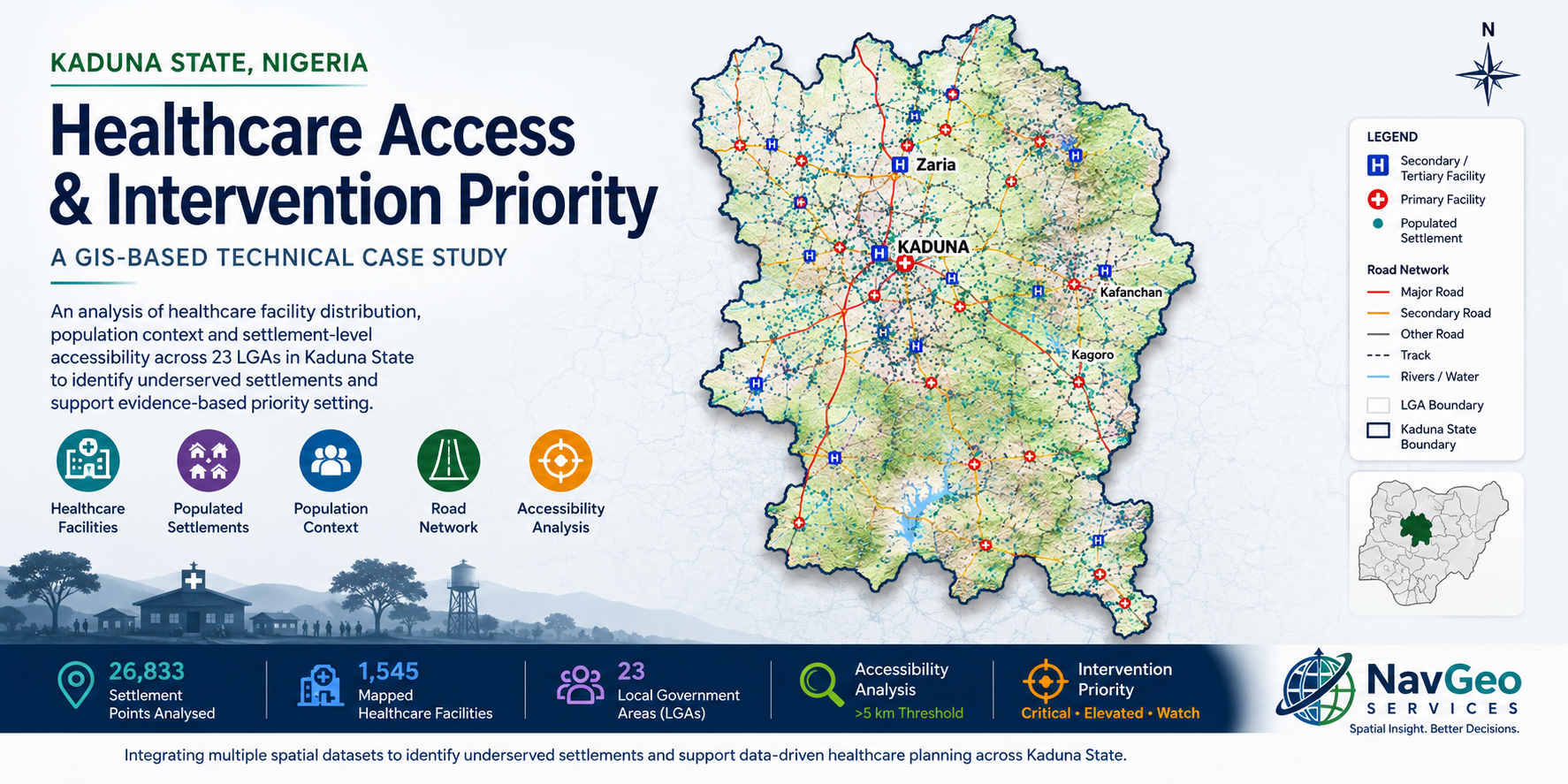
This showcase examines healthcare accessibility across Kaduna State, Nigeria, using settlement, healthcare facility, administrative boundary and road-network data. The analysis identifies differences in healthcare access across the 23 LGAs and highlights settlements where access conditions indicate a greater need for attention.
The work combines healthcare facility distribution, population-relative facility availability, settlement accessibility and LGA-level healthcare access indicators. The results provide a spatial basis for identifying underserved settlements and defining healthcare intervention priorities.
Explore the Interactive StoryMap
View the ArcGIS StoryMap for a visual presentation of healthcare accessibility, underserved settlements and intervention priorities across Kaduna State.
The Challenge
Healthcare facilities are not evenly distributed across Kaduna State, and facility counts alone do not show whether settlements have practical access to healthcare. A settlement may be located in an LGA with several facilities but still be far from its nearest mapped healthcare facility, while population differences can also affect the level of healthcare provision available across LGAs.
The analysis therefore needed to examine healthcare provision from both sides: the distribution of facilities and the accessibility of settlements. It also needed a consistent way to identify where poor settlement-level access coincides with wider healthcare access pressure at LGA level.
Our Approach
The analysis was organised around five linked components: healthcare facility distribution, population-relative facility availability, settlement accessibility, LGA-level healthcare access priority, and settlement-level intervention priority. Each component addressed a different part of the accessibility question while using a common set of administrative and spatial reference data.
Healthcare facilities were examined by location, level, type and ownership, together with facility availability relative to population. Settlement accessibility was assessed using straight-line distance to the nearest mapped healthcare facility. These results were combined with LGA-level healthcare access conditions to identify underserved settlements and classify them into Critical, Elevated and Watch intervention priorities.
Key Results
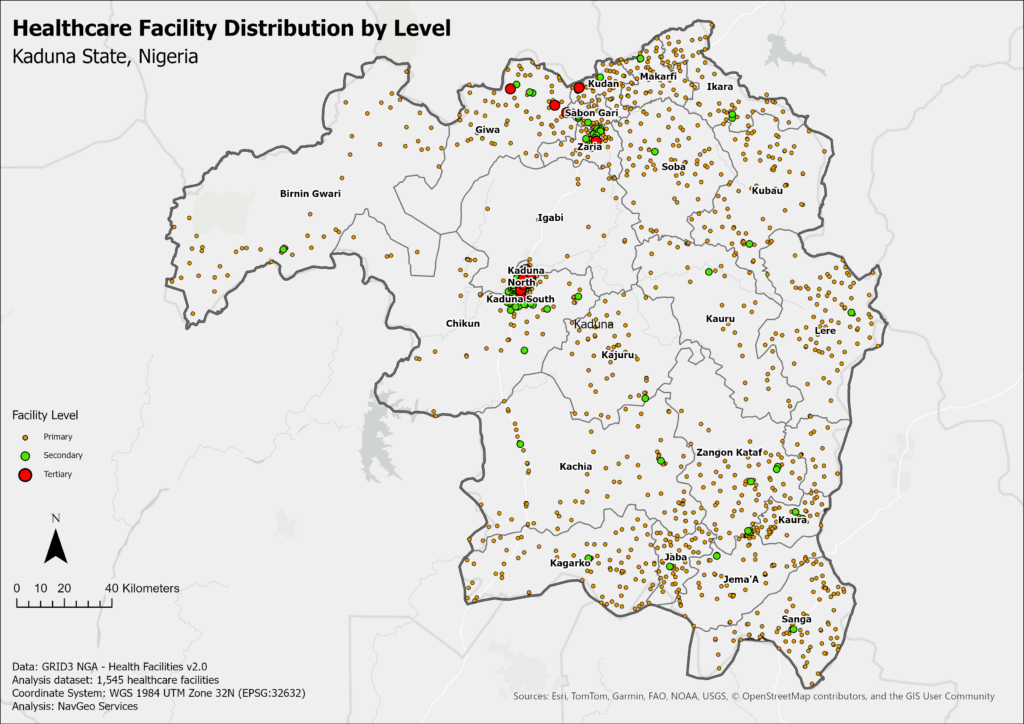
The analysis identified clear differences in healthcare provision and settlement accessibility across Kaduna State. The main findings were:
- Healthcare facilities are unevenly distributed across Kaduna State, with clear differences in facility availability and healthcare level between LGAs.
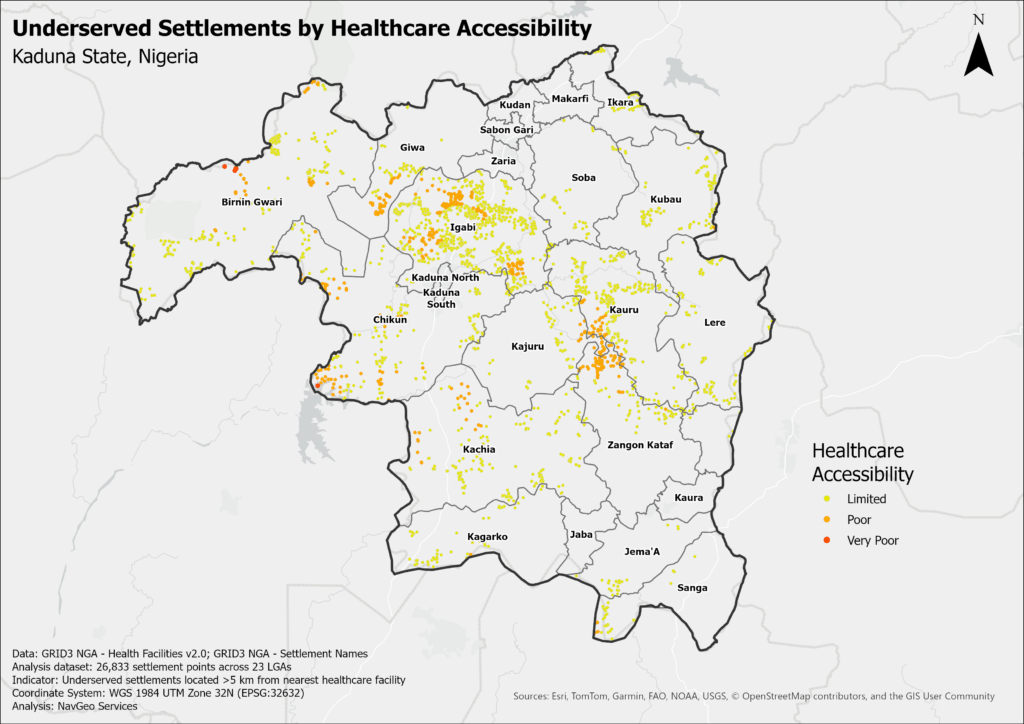
- Settlement accessibility varies considerably across the state, with underserved settlements identified where straight-line distance to the nearest mapped healthcare facility exceeds 5 km.
- The combined accessibility assessment identified 2,857 underserved settlements requiring different levels of attention.
- Of these underserved settlements, 307 were classified as Critical, 1,655 as Elevated and 895 as Watch.
- Critical-priority settlements were concentrated most strongly in Igabi, with 157 settlements, followed by Chikun with 62.
Healthcare Intervention Priority
The intervention-priority assessment brings the settlement accessibility results together with the healthcare access conditions of each LGA. This separates underserved settlements into practical priority groups instead of treating all areas with poor access in the same way.
Critical settlements represent the highest intervention priority, where poor settlement accessibility coincides with higher LGA-level healthcare access priority. Elevated and Watch categories identify progressively lower levels of combined priority. This provides a structured basis for deciding where further assessment, service planning or targeted healthcare intervention should be considered first.
| Intervention Priority | Settlements | Share |
| Critical | 307 | 10.7% |
| Elevated | 1,655 | 57.9% |
| Watch | 895 | 31.3% |
| Total | 2,857 | 100.0% |

What This Analysis Provides
The analysis converts healthcare facility, population and settlement data into mapped and measurable information that can support healthcare access assessment and planning, with road-network data providing additional context for Critical settlements. The main outputs include:
- Healthcare facility distribution by LGA, facility level, type and ownership
- Population-relative healthcare facility availability by LGA
- Settlement-level healthcare accessibility based on distance to the nearest mapped healthcare facility
- LGA-level healthcare access priority classification
- Identification of underserved settlements and Critical, Elevated and Watch intervention priorities
- Road-proximity, nearest-facility and road-type context for Critical settlements
Related NavGeo Service: Spatial Data Processing & Analysis
Technical Scope & Interpretation Boundary
This showcase is based on secondary spatial datasets and GIS-based accessibility analysis. The results describe patterns within the datasets and analytical rules used for the study and should not be interpreted as a field-verified assessment of healthcare service availability, facility capacity or actual patient travel behaviour.
Healthcare accessibility is assessed using straight-line distance between settlement points and the nearest mapped healthcare facility. Road-network information is used to examine proximity to the nearest mapped road and road-type context for Critical settlements. These measures do not represent actual travel distance, travel time, road condition or transport availability.
The intervention-priority classes are analytical planning indicators intended to help identify locations for further assessment; they do not represent formal healthcare policy, funding decisions or confirmed requirements for new facilities.
Full Technical Case Study
A detailed technical case study is available for readers who want to review the complete analytical framework, methods, maps, results and interpretation of the Kaduna healthcare accessibility analysis.
The full case study documents the data preparation, healthcare facility and population analysis, settlement accessibility assessment, Critical-settlement road and facility context, LGA healthcare access priority and settlement-level intervention priority assessment.